
- Python Extension For Visual Studio Code Download Offline
- Sample Python Code For Visual Studio
- Visual Studio Code Extension For Python
Working with Python in Visual Studio Code, using the Microsoft Python extension, is simple, fun, and productive. The extension makes VS Code an excellent Python editor, and works on any operating system with a variety of Python interpreters. It leverages all of VS Code's power to provide auto complete and IntelliSense, linting, debugging, and unit testing, along with the ability to easily switch between Python environments, including virtual and conda environments.
This article provides only an overview of the different capabilities of the Python extension for VS Code. For a walkthrough of editing, running, and debugging code, use the button below.
Install Python and the Python extension
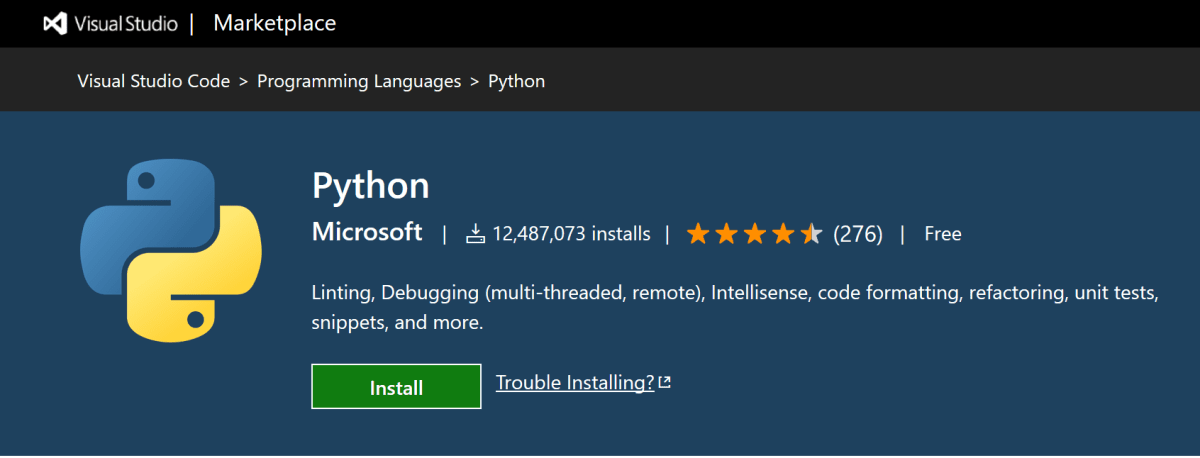
The tutorial guides you through installing Python and using the extension. You must install a Python interpreter yourself separately from the extension. For a quick install, use Python 3.7 from python.org and install the extension from the VS Code Marketplace.
Close all instances of VS Code; Next, launch VS Code from that same terminal (command window) session (venv) ter @minal: $ code. Python Version used for debugging. Details on configuration settings for debugging can be found here Debugging. Configuring the version of the python executable is no longer necessary. The Python extension for Visual Studio Code. The Azure Functions extension for Visual Studio Code. Create your local project In this section, you use Visual Studio Code to create a local Azure Functions project in Python. See more: visual studio code python repl, please configure your git username and email. Visual studio code, visual studio code python uml, visual studio code python, how to run python in visual studio code, visual studio code opencv python, visual studio code python virtualenv, python extension for visual studio code, how to run.
Once you have a version of Python installed, activate it using the Python: Select Interpreter command. If VS Code doesn't automatically locate the interpreter you're looking for, refer to Environments - Manually specify an interpreter.
You can configure the Python extension through settings. Learn more in the Python Settings reference.
Windows Subsystem for Linux: If you are on Windows, WSL is a great way to do Python development. You can run Linux distributions on Windows and Python is often already installed. When coupled with the Remote - WSL extension, you get full VS Code editing and debugging support while running in the context of WSL. To learn more, go to Developing in WSL or try the Working in WSL tutorial.
Insiders program
The Insiders program allows you to try out and automatically install new versions of the Python extension prior to release, including new features and fixes.
If you'd like to opt into the program, you can either open the Command Palette (⇧⌘P (Windows, Linux Ctrl+Shift+P)) and select Python: Switch to Insiders Daily/Weekly Channel or else you can open settings (⌘, (Windows, Linux Ctrl+,)) and look for Python: Insiders Channel to set the channel to 'daily' or 'weekly'.
Run Python code
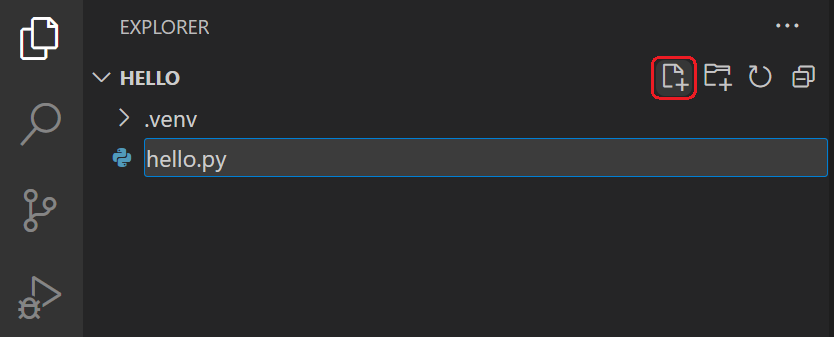
To experience Python, create a file (using the File Explorer) named hello.py and paste in the following code (assuming Python 3):
The Python extension then provides shortcuts to run Python code in the currently selected interpreter (Python: Select Interpreter in the Command Palette):
- In the text editor: right-click anywhere in the editor and select Run Python File in Terminal. If invoked on a selection, only that selection is run.
- In Explorer: right-click a Python file and select Run Python File in Terminal.
You can also use the Terminal: Create New Integrated Terminal command to create a terminal in which VS Code automatically activates the currently selected interpreter. See Environments below. The Python: Start REPL activates a terminal with the currently selected interpreter and then runs the Python REPL.
For a more specific walkthrough on running code, see the tutorial.
Autocomplete and IntelliSense
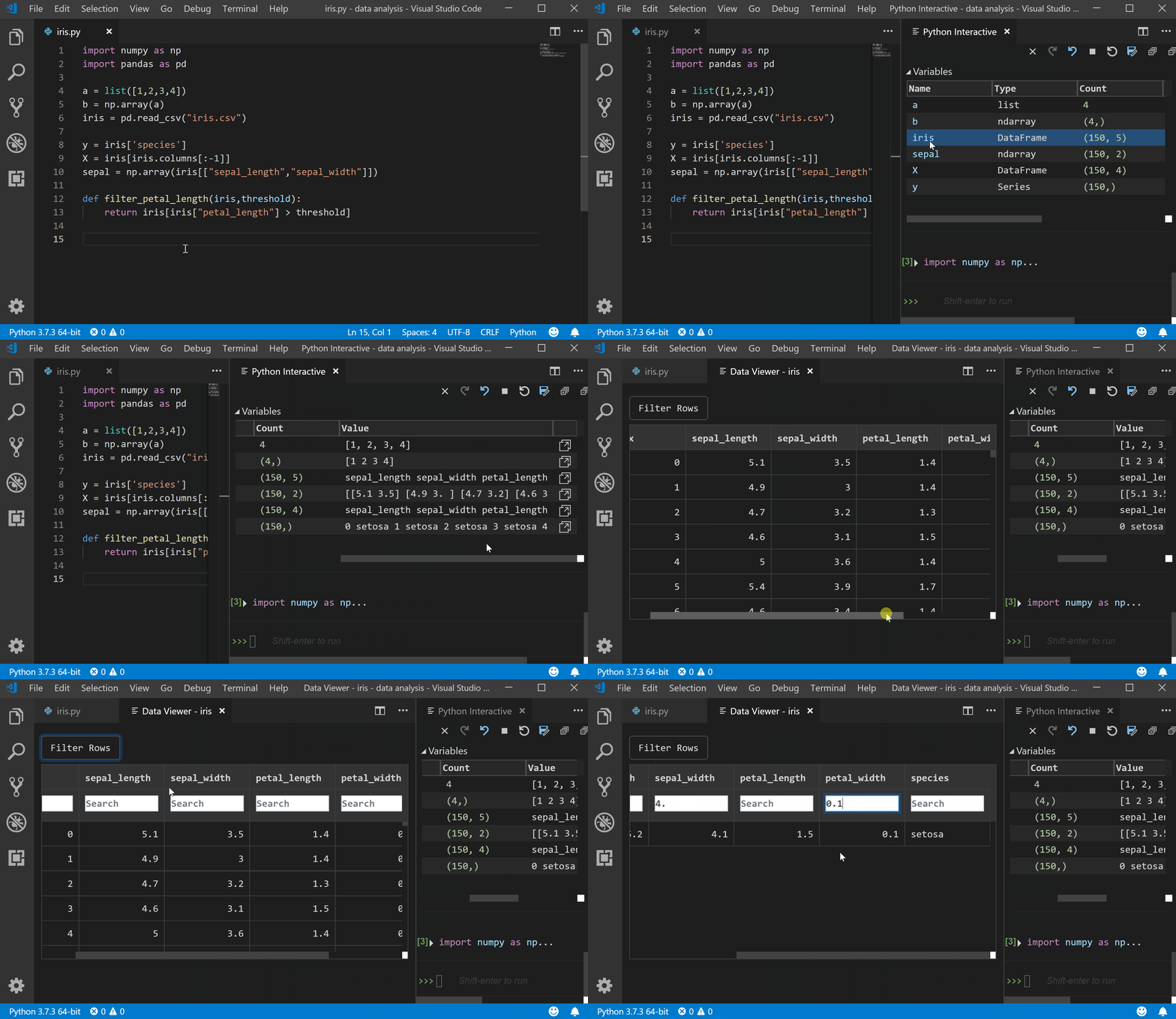
The Python extension supports code completion and IntelliSense using the currently selected interpreter. IntelliSense is a general term for a number of features, including intelligent code completion (in-context method and variable suggestions) across all your files and for built-in and third-party modules.
IntelliSense quickly shows methods, class members, and documentation as you type, and you can trigger completions at any time with ⌃Space (Windows, Linux Ctrl+Space). You can also hover over identifiers for more information about them.
Tip: Check out the IntelliCode extension for VS Code (preview). IntelliCode provides a set of AI-assisted capabilities for IntelliSense in Python, such as inferring the most relevant auto-completions based on the current code context.
Linting
Linting analyzes your Python code for potential errors, making it easy to navigate to and correct different problems.
The Python extension can apply a number of different linters including Pylint, pycodestyle, Flake8, mypy, pydocstyle, prospector, and pylama. See Linting.
Debugging
No more print statement debugging! Set breakpoints, inspect data, and use the debug console as you run your program step by step. Debug a number of different types of Python applications, including multi-threaded, web, and remote applications.
For Python-specific details, including setting up your launch.json configuration and remote debugging, see Debugging. General VS Code debugging information is found in the debugging document. The Django and Flask tutorials also demonstrate debugging in the context of those web apps, including debugging Django page templates.
Environments
The Python extension automatically detects Python interpreters that are installed in standard locations. It also detects conda environments as well as virtual environments in the workspace folder. See Configuring Python environments. You can also use the python.pythonPath setting to point to an interpreter anywhere on your computer.
The current environment is shown on the left side of the VS Code Status Bar:
The Status Bar also indicates if no interpreter is selected:
The selected environment is used for IntelliSense, auto-completions, linting, formatting, and any other language-related feature other than debugging. It is also activated when you use run Python in a terminal.
To change the current interpreter, which includes switching to conda or virtual environments, select the interpreter name on the Status Bar or use the Python: Select Interpreter command.
VS Code prompts you with a list of detected environments as well as any you've added manually to your user settings (see Configuring Python environments).
Installing packages
Packages are installed using the Terminal panel and commands like pip install <package_name> (Windows) and pip3 install <package_name> (macOS/Linux). VS Code installs that package into your project along with its dependencies. Examples are given in the Python tutorial as well as the Django and Flask tutorials.
Jupyter notebooks
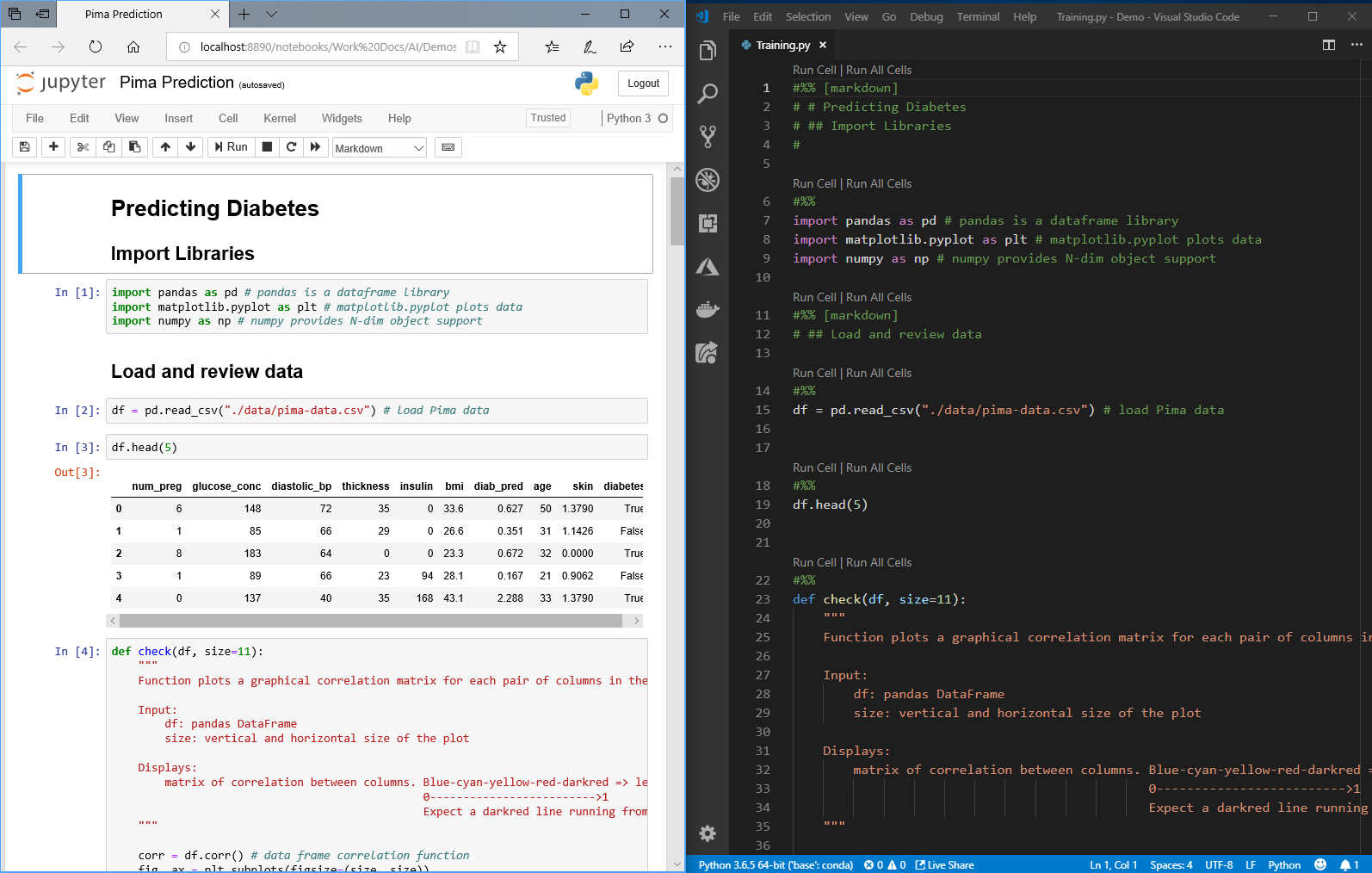
If you open a Jupyter notebook file (.ipynb) in VS Code, you can use the Jupyter Notebook Editor to directly view, modify, and run code cells.
You can also convert and open the notebook as a Python code file. The notebook's cells are delimited in the Python file with #%% comments, and the Python extension shows Run Cell or Run All Cells CodeLens. Selecting either CodeLens starts the Jupyter server and runs the cell(s) in the Python interactive window:
Opening a notebook as a Python file allows you to use all of VS Code's debugging capabilities. You can then save the notebook file and open it again as a notebook in the Notebook Editor, Jupyter, or even upload it to a service like Azure Notebooks.
Using either method, Notebook Editor or a Python file, you can also connect to a remote Jupyter server for running the code. For more information, see Jupyter support.
Testing
The Python extension supports testing with the unittest, pytest, and nose test frameworks.
To run tests, you enable one of the frameworks in settings. Each framework also has specific settings, such as arguments that identify paths and patterns for test discovery.
Once discovered, VS Code provides a variety of commands (on the Status Bar, the Command Palette, and elsewhere) to run and debug tests, including the ability to run individual test files and individual methods.
Configuration
The Python extension provides a wide variety of settings for its various features. These are described on their relevant topics, such as Editing code, Linting, Debugging, and Testing. The complete list is found in the Settings reference.
Other popular Python extensions
The Microsoft Python extension provides all of the features described previously in this article. Additional Python language support can be added to VS Code by installing other popular Python extensions.
- Open the Extensions view (⇧⌘X (Windows, Linux Ctrl+Shift+X)).
- Filter the extension list by typing 'python'.
The extensions shown above are dynamically queried. Click on an extension tile above to read the description and reviews to decide which extension is best for you. See more in the Marketplace.
Next steps
- Python Hello World tutorial - Get started with Python in VS Code.
- Editing Python - Learn about auto-completion, formatting, and refactoring for Python.
- Basic Editing - Learn about the powerful VS Code editor.
- Code Navigation - Move quickly through your source code.
In this article, you use Visual Studio Code to create a Python function that responds to HTTP requests. After testing the code locally, you deploy it to the serverless environment of Azure Functions.
Completing this quickstart incurs a small cost of a few USD cents or less in your Azure account.
There's also a CLI-based version of this article.
Configure your environment
Before you get started, make sure you have the following requirements in place:
An Azure account with an active subscription. Create an account for free.
The Azure Functions Core Tools version 3.x.
Visual Studio Code on one of the supported platforms.
The Python extension for Visual Studio Code.
The Azure Functions extension for Visual Studio Code.
Create your local project
In this section, you use Visual Studio Code to create a local Azure Functions project in Python. Later in this article, you'll publish your function code to Azure.
Choose the Azure icon in the Activity bar, then in the Azure: Functions area, select the Create new project.. icon.
Choose a directory location for your project workspace and choose Select.
Note
These steps were designed to be completed outside of a workspace. In this case, do not select a project folder that is part of a workspace.
Provide the following information at the prompts:
Select a language for your function project: Choose
Python.Select a Python alias to create a virtual environment: Choose the location of your Python interpreter.
If the location isn't shown, type in the full path to your Python binary.Select a template for your project's first function: Choose
HTTP trigger.Provide a function name: Type
HttpExample.Authorization level: Choose
Anonymous, which enables anyone to call your function endpoint. To learn about authorization level, see Authorization keys.Select how you would like to open your project: Choose
Add to workspace.
Using this information, Visual Studio Code generates an Azure Functions project with an HTTP trigger. You can view the local project files in the Explorer. To learn more about files that are created, see Generated project files.
Run the function locally
Visual Studio Code integrates with Azure Functions Core tools to let you run this project on your local development computer before you publish to Azure.
To call your function, press F5 to start the function app project. Output from Core Tools is displayed in the Terminal panel. Your app starts in the Terminal panel. You can see the URL endpoint of your HTTP-triggered function running locally.
If you have trouble running on Windows, make sure that the default terminal for Visual Studio Code isn't set to WSL Bash.
With Core Tools running, go to the Azure: Functions area. Under Functions, expand Local Project > Functions. Right-click (Windows) or Ctrl - click (macOS) the
HttpExamplefunction and choose Execute Function Now...In Enter request body you see the request message body value of
{ 'name': 'Azure' }. Press Enter to send this request message to your function.You could have instead sent an HTTP GET request to the
http://localhost:7071/api/HttpExampleaddress in a web browser.When the function executes locally and returns a response, a notification is raised in Visual Studio Code. Information about the function execution is shown in Terminal panel.
Press Ctrl + C to stop Core Tools and disconnect the debugger.
After you've verified that the function runs correctly on your local computer, it's time to use Visual Studio Code to publish the project directly to Azure.
Sign in to Azure
Python Extension For Visual Studio Code Download Offline
Download tx studio for mac. Before you can publish your app, you must sign in to Azure.
If you aren't already signed in, choose the Azure icon in the Activity bar, then in the Azure: Functions area, choose Sign in to Azure... If you don't already have one, you can Create a free Azure account. Students can create a free Azure account for Students.
If you're already signed in, go to the next section.
When prompted in the browser, choose your Azure account and sign in using your Azure account credentials.
After you've successfully signed in, you can close the new browser window. The subscriptions that belong to your Azure account are displayed in the Side bar.
Publish the project to Azure
In this section, you create a function app and related resources in your Azure subscription and then deploy your code.
Important
Publishing to an existing function app overwrites the content of that app in Azure.
Choose the Azure icon in the Activity bar, then in the Azure: Functions area, choose the Deploy to function app.. button.
Provide the following information at the prompts:
Select folder: Choose a folder from your workspace or browse to one that contains your function app.
You won't see this if you already have a valid function app opened.Select subscription: Choose the subscription to use.
You won't see this if you only have one subscription.Select Function App in Azure: Choose
+ Create new Function App.
(Don't choose theAdvancedoption, which isn't covered in this article.)Enter a globally unique name for the function app: Type a name that is valid in a URL path. The name you type is validated to make sure that it's unique in Azure Functions.
Select a runtime: Choose the version of Python you've been running on locally. You can use the
python --versioncommand to check your version.Select a location for new resources: For better performance, choose a region near you.
The extension shows the status of individual resources as they are being created in Azure in the notification area.
When completed, the following Azure resources are created in your subscription, using names based on your function app name:
- A resource group, which is a logical container for related resources.
- A standard Azure Storage account, which maintains state and other information about your projects.
- A consumption plan, which defines the underlying host for your serverless function app.
- A function app, which provides the environment for executing your function code. A function app lets you group functions as a logical unit for easier management, deployment, and sharing of resources within the same hosting plan.
- An Application Insights instance connected to the function app, which tracks usage of your serverless function.
A notification is displayed after your function app is created and the deployment package is applied.
Tip
By default, the Azure resources required by your function app are created based on the function app name you provide. By default, they are also created in the same new resource group with the function app. If you want to either customize the names of these resources or reuse existing resources, you need to instead publish the project with advanced create options.
Select View Output in this notification to view the creation and deployment results, including the Azure resources that you created. If you miss the notification, select the bell icon in the lower right corner to see it again.
Run the function in Azure
Back in the Azure: Functions area in the side bar, expand your subscription, your new function app, and Functions. Right-click (Windows) or Ctrl - click (macOS) the
HttpExamplefunction and choose Execute Function Now...In Enter request body you see the request message body value of
{ 'name': 'Azure' }. Press Enter to send this request message to your function.When the function executes in Azure and returns a response, a notification is raised in Visual Studio Code.
Clean up resources
When you continue to the next step and add an Azure Storage queue binding to your function, you'll need to keep all your resources in place to build on what you've already done.
Otherwise, you can use the following steps to delete the function app and its related resources to avoid incurring any further costs.
Sample Python Code For Visual Studio
In Visual Studio Code, press F1 to open the command palette. In the command palette, search for and select
Azure Functions: Open in portal.Choose your function app, and press Enter. The function app page opens in the Azure portal.
In the Overview tab, select the named link next to Resource group.
In the Resource group page, review the list of included resources, and verify that they are the ones you want to delete.
Select Delete resource group, and follow the instructions.
Deletion may take a couple of minutes. When it's done, a notification appears for a few seconds. You can also select the bell icon at the top of the page to view the notification.
To learn more about Functions costs, see Estimating Consumption plan costs.
Next steps
Visual Studio Code Extension For Python
You have used Visual Studio Code to create a function app with a simple HTTP-triggered function. In the next article, you expand that function by connecting to Azure Storage. To learn more about connecting to other Azure services, see Add bindings to an existing function in Azure Functions.